The Man With The Master Plan
Thoughts on the new Billy Preston documentary

Greetings New Dimensions readers, and hope everyone is trying to keep cool as we head into a hot August.
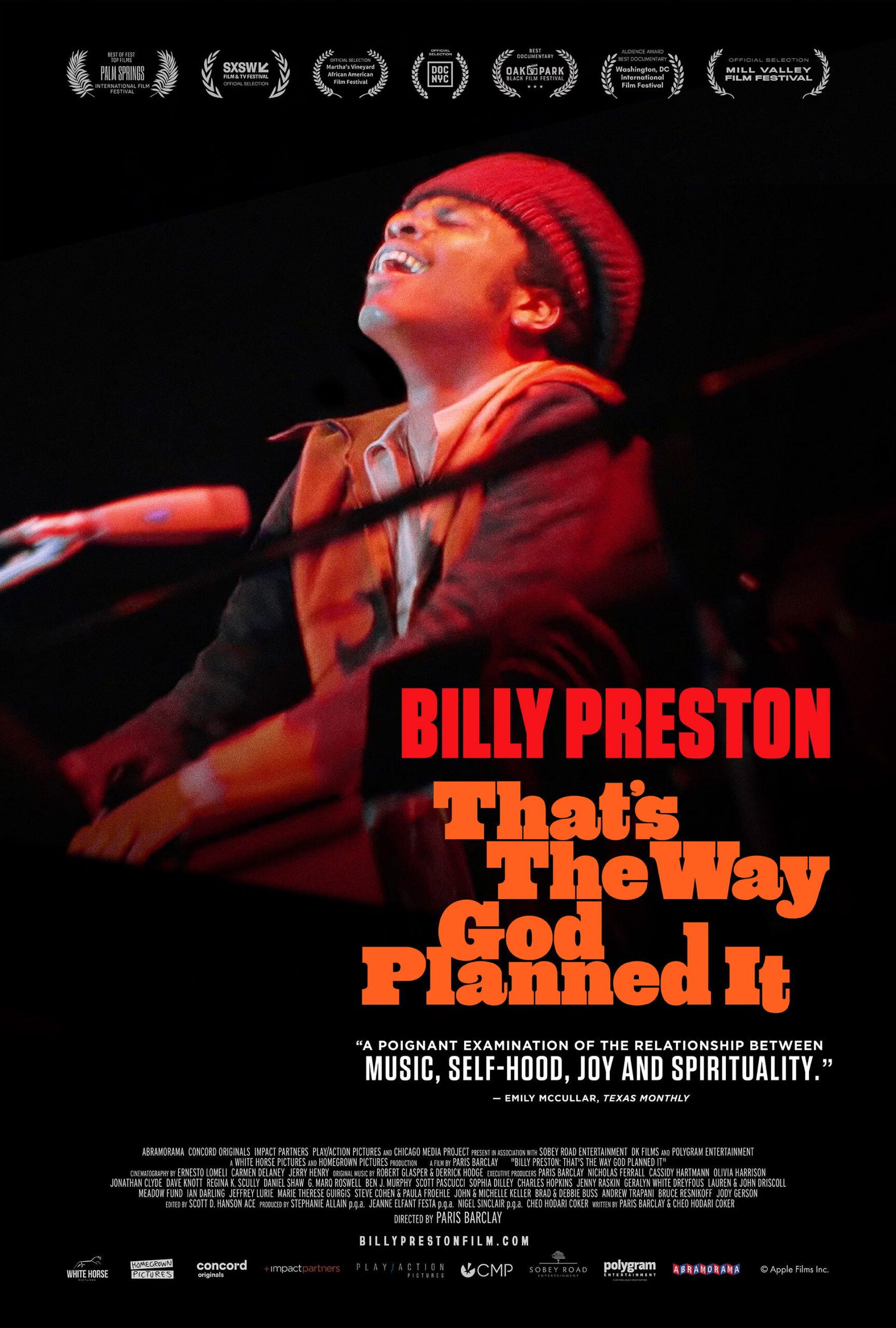
This week I had the pleasure of seeing the new Billy Preston documentary, “That’s The Way God Planned It” in the theatre with my father. I’d heard good things about the film, and being a fan of music documentaries, when I noticed the local cinema was screening it, it seemed like an obvious thing to do; nothing beats the cool cinema during a heat wave. As luck would have it, my pal Frank was in from Chicago this past week, and so we had the good fortune of having him join us, as a fellow film enthusiast and music lover-record collector.
There was never any doubt that a documentary about Billy Preston was an uphill climb; it’s the same reason that there’s no biography on Preston. That’s not due to any lack of talent, and his life was a remarkable one, having performed with many prominent artists, chief among them the Beatles, Rolling Stones, Ray Charles, Aretha Franklin, Little Richard…the list goes on. Then there’s the slew of top hits and albums recorded by Preston during his 1960s and 1970s peak. He was endlessly creative and as many attest to in the film, incredibly encouraging; the man could spark up a room the moment he entered it, and electrify it the moment he sat down at the Hammond B-3. Look for no further proof than the footage of the Beatles ‘Get Back’ sessions; its clear he single-handily drove the band in the studio upon first jamming with them.
What few knew, beyond his closest musical friends, was his hellish private life. While the film makes the case that Billy Preston was a closeted gay man for most of his life, though I wonder how much sexuality played a part in his life; he seemed to enjoy the company of friends and making music and lacked the ability to form close sexual relationships with anyone. It’s notable that no lovers or personal companions of his were interviewed in the film, female or male. It certainly seems that, beyond the public persona, he was a lonely guy - his music was literally his life, and he gave his life to making people happy and entertaining. Watching the bounty of rare TV performances and concert footage of Preston, it’s obvious that even from his earliest days as a child prodigy in the church, performing meant everything to him. We see Preston go from his earliest days as a church pianist, to forming the gospel group the COGICS, through to his first forays into secular music.
As the documentary tells it, Preston’s first introduction to the rock ‘n’ roll world came when he accompanied Little Richard on a 1962 UK tour; as fate would have it, it was on this European Tour when the band played several weeks at the Star-Club in Hamburg, sharing the bill with a quartet from Liverpool about to break big. The Beatles connected with Preston, and that bond would tighten seven years later when he joined them in the studio to help finish their “Let it Be” album, as well as playing on “Abbey Road”.
The producers of the Billy Preston documentary managed to get a host of talents involved and willing to give on camera interviews; beyond the household names (Ringo Starr, Eric Clapton) they wisely focused on musical collaborators who are seldom interviewed, including the members of Preston’s A&M Records-era band; his songwriting partner, Bruce Fisher; and guitarist and songwriter Keni Burke, who started in the Five Stairsteps and became friends and musical collaborators with Preston.
Beyond playing together, Burke and Preston also shared a common bond: a friendship with George Harrison. (He signed Burke in 1974 to his Dark Horse label). It’s clear that Preston and Harrison’s friendship ran deep, beyond the musical and to a more spiritual level. Harrison’s widow Olivia testifies to their close bond (she also served as an executive producer). This also means we are treated to Billy’s performance of “That’s the Way God Planned It” from the Concert From Bangla-Desh, which opens up the new film; along with pro-shot footage from the 1974 Dark Horse tour.
As I alluded to earlier, making a documentary about Billy Preston is a challenge; he died in 2006, so the film utilizes several archival interviews, from the sixties through to the 2000s, which allows the subject to share some wonderful stories, as its clear Billy could tell tales and had a genuine warmth about him. He’s can spin a yarn and keep you entertained. But since Preston was such a tightly guarded person, we as viewers are left with the puzzle of who he was behind the persona. The film alludes to him suffering abuse of a sexual nature as a child, but no details are provided nor is anyone accused or named. Likewise, the film doesn’t shy away from discussing Preston’s troubles with alcohol and drugs, and how it led to his personal and professional demise in the 1980s and 1990s. At his lowest point, the artist was arrested for numerous serious crimes and jailed for several years. The judge who handed down the sentence is interviewed in the documentary, the first time he’d ever consented to be interviewed about any of his rulings, as he notes; he felt that Billy Preston’s case deserved to be a learning lesson. Had he not been high, the judge felt he would not have been capable of these crimes.
Things turn around when Preston is released from jail at the dawn of the Millennium, and quickly sets about righting wrongs and getting back to his love of music. Eric Clapton takes him under his wing and on tour, being both a friend and employer as well as an AA sponsor. Studio work, new albums and world tours keep him busy, but at some point, Preston falls off the wagon, goes back to his old ways. At least that’s how it seems in the film. He does get to reconnect with his mentor Ray Charles, and they have the chance to record together one last time. The documentary makes it seem that the deaths of Charles and Preston’s mother in 2004 and 2005 is the trigger for his sobriety derailment. Whatever the case, it’s still heartwarming that the musician managed to get acclaim and recognition during the last few years of his life.
Well shot and produced, with no shortage of music and interviews, “Billy Preston: That’s the Way God Planned It” is well-worth seeing, for its a quality production and a captivating story. By focusing on first-hand testimonies from those who knew him, it helps share some of his story, and with any luck, hopefully will turn lots of viewers and new listeners onto his musical catalogue, which is well worth discovering. That’s what would’ve made Billy Preston the happiest, one imagines, that his music and joy is still being shared, all these years later.